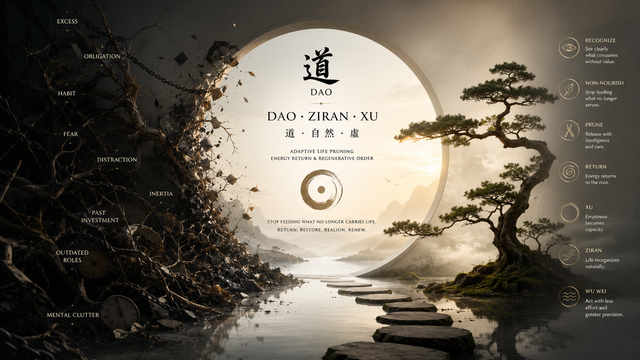
Adaptive Life Pruning, Energy Return & Regenerative Order
Purpose
DAO · ZIRAN · XU is a premium morphic field for people whose lives feel crowded by outdated commitments, unfinished directions, habitual obligations, excessive stimulation and demands that continue consuming attention long after their real value has diminished.
Its purpose is to identify what no longer deserves continued investment, withdraw the energy that keeps it active, release what has completed its function and return scattered personal resources to the center.
The field then protects the space that opens, allowing priorities, responsibilities and daily action to reorganize around what remains meaningful, necessary and genuinely alive.
It is guided by three complementary Taoist principles:
DAO — 道
The underlying Way: the deeper order that becomes accessible when excess, interference and unnecessary resistance are reduced.
ZIRAN — 自然
Natural self-organization: the capacity of life to return to a more authentic rhythm once artificial pressure, inherited expectations and obsolete structures lose their influence.
XU — 虛
Fertile emptiness: the open and receptive space that makes rest, clarity, movement, creativity and renewal possible.
The field is built around a simple understanding:
A person may not always need more energy, motivation, discipline or opportunities.
Sometimes the real need is to stop nourishing what has become unnecessary, recover the resources trapped within it and create enough space for a more natural order to emerge.
Its central progression is:
Recognize the excess.
Stop feeding what no longer serves.
Prune what has completed its function.
Let scattered energy return.
Restore fertile space.
Allow life to reorganize naturally.
Act with less resistance and greater precision.
This Field May Be Especially Relevant When
Too many unfinished commitments remain active in the background.
Life feels crowded even when no single problem explains the overload.
Attention is divided among projects, roles or goals that no longer feel alive.
Letting go creates guilt, uncertainty or fear of wasted investment.
Responsibilities have expanded beyond their original purpose.
Rest feels uncomfortable unless it is immediately made productive.
Every newly opened space is quickly filled with another obligation.
What is needed is less internal occupation rather than more stimulation.
The field does not encourage impulsive detachment, irresponsibility or withdrawal from meaningful commitments.
It works through intelligent selection, helping distinguish what remains valuable from what continues only through habit, guilt, fear, previous investment or external expectation.
Functional Architecture / Modules
Module 1 — Daoic Life-Ecology Recognition
The field begins by observing life as an interconnected ecology of attention, energy, habits, responsibilities, relationships and unfinished directions.
It identifies where personal resources are being used meaningfully and where they have become scattered, trapped or disproportionately consumed.
This may include:
Habits sustained through inertia
Projects that absorb more than they return
Commitments maintained through guilt
Roles that no longer represent the user
Goals inherited from a previous identity
Repetitive obligations with little remaining value
Excessive information and digital stimulation
Unresolved tasks occupying persistent mental space
Relationships shaped by chronic overextension
Areas of life that remain active because they were never consciously closed
The purpose is not to expose personal defects.
It is to reveal where life has become overgrown, congested or poorly distributed.
At the same time, the field protects essential responsibilities, meaningful relationships, necessary routines, practical stability and projects that retain genuine purpose.
Module 2 — Non-Nourishment of the Unnecessary
Many patterns remain active because they continue receiving attention, emotional charge, resistance, repetition or identification.
This module applies one of the central mechanisms of the field:
What no longer deserves to grow gradually stops receiving nourishment.
Rather than fighting every unwanted structure directly, the field reduces the resources that keep it influential.
It may weaken:
Repetitive mental investment
Emotional attachment to completed situations
Guilt-based obligation
Fear of disappointing others
Approval-seeking
Compulsive monitoring
Identification with outdated roles
The pressure to finish everything ever started
The need to remain constantly productive
The tendency to continue investing because of previous effort
As unnecessary structures receive less attention and reinforcement, their capacity to direct life begins to diminish naturally.
This is not passive avoidance.
It is the conscious withdrawal of resources from what no longer justifies its continuation.
Module 3 — Adaptive Pruning & Conscious Release
Once something has been recognized and no longer receives automatic nourishment, the field supports its selective release.
It may work on:
Harmful habits
Exhausted commitments
Misaligned goals
Outdated routines
Inherited expectations
Unnecessary obligations
Projects without meaningful future potential
Internal rules that create needless complexity
Identities that have completed their developmental function
Activities maintained only through familiarity or inertia
The pruning process remains adaptive.
It does not treat everything difficult or uncomfortable as something that should be removed. Some challenges remain necessary for responsibility, growth or long-term development.
The field helps distinguish between:
Meaningful effort and chronic depletion
Persistence and sunk-cost attachment
Loyalty and self-abandonment
Responsibility and unnecessary burden
Temporary difficulty and completed purpose
Genuine opportunity and distracting expansion
Where appropriate, it supports conscious closure, reduced involvement, delegation, renegotiation, reprioritization and release of attachment.
The learning remains.
The unnecessary continuation is released.
Module 4 — Gui Gen: Energy Return to the Root
When attention and emotional investment are withdrawn from exhausted structures, the resources attached to them can return.
Gui Gen represents the movement back toward the root: the return of scattered personal energy to the user’s center.
This module recovers resources invested in:
Unfinished plans
Repetitive anticipation
Old obligations
Excessive decision-making
Constant comparison
Emotional over-responsibility
Projects maintained only in thought
Fear of missing opportunities
Roles requiring continuous performance
Background mental activity that never fully rests
The returning resources may include:
Attention
Motivation
Emotional energy
Creative capacity
Will
Presence
Decision-making capacity
Capacity for rest
Availability for meaningful action
The field does not attempt to create artificial stimulation.
It helps the user become more available because less of the system remains unnecessarily dispersed.
The resources that once maintained obsolete structures can gradually return toward health, recovery, creativity, valuable relationships, meaningful work and practical stability.
Release does not merely create absence. It returns resources.
Module 5 — Xu: Fertile Emptiness
After clearing, the newly opened space must be protected and integrated.
Many people experience emptiness as anxiety, wasted time or an invitation to immediately begin something new. This can recreate the same saturation the field has just reduced.
This module restores the functional quality of Xu.
Xu is not lifeless absence.
It is usable capacity.
The module supports:
Mental breathing room
Emotional spaciousness
Rest without guilt
Quiet without discomfort
Reduced urgency
Less compulsive stimulation
Creative incubation
Greater receptivity
Tolerance for uncertainty
Freedom from constant input
The field helps the system recognize that open space can be valuable before it becomes productive.
Not every pause needs to generate an answer.
Not every silence needs to be filled.
Not every period of rest needs to justify itself.
Fertile emptiness becomes the protected chamber through which renewal and future direction can emerge.
Module 6 — Ziran: Natural Reorganization
Once excess has been reduced, resources have returned and open space has been restored, the field supports a more natural reorganization of life.
Ziran does not impose a rigid new identity or predetermined structure.
It helps what remains genuine, necessary and alive recover its appropriate place.
Priorities and commitments are gradually reorganized according to:
Present reality
Actual capacity
Personal meaning
Natural timing
Long-term value
Available energy
Genuine responsibility
Sustainable effort
Current needs rather than past identities
This may help meaningful projects receive more coherent attention, responsibilities become more proportionate, healthy relationships occupy a more balanced place and useful habits become easier to maintain.
The field does not attempt to optimize every detail of life.
It reduces interference so that a more coherent order can emerge from within the system itself.
The result is not a perfectly controlled life.
It is a life that becomes easier to inhabit because its structure increasingly reflects what is real.
Module 7 — Wu Wei: Proportionate Action & Renewal Preservation
The final module translates the restored order into a cleaner relationship with action.
Wu Wei is applied here as proportionate action: doing what is necessary without creating additional friction, waste or over-intervention.
This module supports:
Acting at the appropriate moment
Using sufficient rather than excessive effort
Recognizing when further action adds no value
Choosing simpler solutions
Reducing compulsive activity
Working with existing momentum
Allowing natural pauses
Making decisions with less internal conflict
Protecting the resources restored by the previous modules
It also helps prevent reaccumulation.
The field encourages a conscious pause before accepting new projects, responsibilities, obligations, information streams or expanding roles.
Its governing principles are:
Not every opportunity must become a commitment.
Not every request creates an obligation.
Not every open space needs to be filled.
Not every form of growth deserves nourishment.
This final layer helps make the entire process sustainable: less overload, more deliberate investment and a more precise relationship between energy, action, timing and real value.
Benefits
Helps identify hidden drains on time, attention and personal energy.
Supports recognition of habits, roles and commitments that have completed their function.
Helps distinguish meaningful responsibility from unnecessary burden.
Reduces unconscious nourishment of repetitive or outdated patterns.
Supports the release, reduction, delegation or renegotiation of exhausted commitments.
Helps loosen sunk-cost attachment and habitual continuation.
Preserves useful learning while releasing the burden attached to completed experiences.
Recovers scattered attention, motivation and emotional energy.
Returns personal resources toward rest, creativity, health and meaningful action.
Reduces mental overload caused by unfinished directions and competing demands.
Restores fertile inner space for recovery, reflection and new possibilities.
Encourages a more natural reorganization of priorities and responsibilities.
Supports simpler, more proportionate and better-timed action.
Helps prevent newly restored space from becoming saturated again.
Encourages selective growth rather than constant expansion.
Supports a clearer, lighter and more sustainable relationship with daily life.
Core Philosophy
DAO · ZIRAN · XU does not attempt to transform life through greater pressure.
It removes the pressure that no longer serves.
It does not fight every unwanted pattern.
It stops feeding what no longer deserves to remain active.
It does not treat emptiness as a deficiency.
It restores emptiness as capacity.
It does not force a new identity.
It allows a more natural order to emerge after accumulated interference has been reduced.
It does not encourage withdrawal from responsibility.
It helps responsibility become clearer, more proportionate and more sustainable.
Its governing sequence is:
DAO reveals the deeper order beneath excess.
Non-nourishment weakens what no longer needs continuation.
Adaptive pruning releases what has completed its purpose.
Gui Gen returns scattered energy to the root.
XU restores fertile space.
ZIRAN allows natural reorganization.
Wu Wei converts that order into precise and proportionate action.
The essence of the field is simple:
Stop feeding what no longer carries life.
Release what has completed its function.
Let your energy return.
Protect the space that opens.
Allow what is genuine to reorganize itself naturally.
Act only where action truly matters.
Quick-glance key benefits
Adaptive life pruning · Hidden-drain recognition · Non-nourishment · Conscious release · Sunk-cost freedom · Energy return · Fertile emptiness · Natural reorganization · Proportionate action · Sustainable renewal · Anti-reaccumulation intelligence




Reviews
There are no reviews yet.