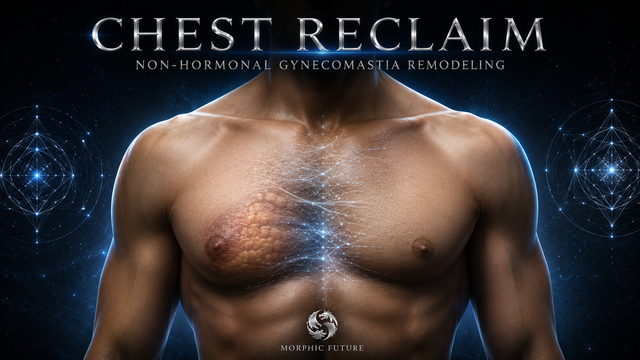
Some chest fullness does not disappear simply because you lose weight.
Sometimes training improves the pectoral muscles, yet the soft, swollen or projecting contour remains. In other cases, becoming leaner only makes the contrast more visible.
That is because the appearance commonly described as gynecomastia may involve more than stored fat. Glandular tissue, fibrotic density, local congestion, skin laxity and the relationship between the areola and the underlying pectoral structure can all influence the final shape of the chest.
Chest Reclaim is a focused morphic field designed to support the progressive remodeling of these local tissue patterns—without attempting to manipulate testosterone, estrogen, prolactin, aromatase or the male endocrine axis.
Its objective is direct and highly specific:
To support a flatter, firmer and more naturally masculine chest contour through localized tissue remodeling.
Purpose
Chest Reclaim works specifically with the physical architecture of the male pectoral region.
Rather than functioning as a general fat-loss field or hormonal-balancing system, it concentrates its signal on the tissue surrounding the chest and nipple–areolar area.
The field is designed to address the different structural components that may contribute to an enlarged, soft or projecting chest:
Excess or persistent glandular-pattern tissue
Localized pectoral fat
Dense or fibrotic tissue organization
Fluid stagnation and local congestion
Loose skin and reduced fascial tension
Puffy or projecting areolar contours
Unevenness between both sides of the chest
Insufficient pectoral tone beneath the superficial tissue
The complete process follows a coordinated progression:
Map → Remodel → Mobilize → Release → Drain → Tighten → Tone → Integrate
Functional Architecture
1. Pectoral Tissue Mapping
The field begins by establishing a precise energetic map of the chest.
It differentiates between the pectoral muscles, glandular-pattern tissue, localized adipose tissue, connective tissue, fascia, skin, lymphatic structures and the nipple–areolar complex.
This mapping allows the subsequent effects to remain concentrated on unwanted superficial volume while preserving the natural architecture and functional integrity of the underlying chest.
It also helps the system recognize differences between both sides, allowing the remodeling process to respond more intelligently to asymmetry.
2. Glandular-Tissue Remodeling
This is the principal module for the glandular component associated with true gynecomastia-type tissue.
It introduces a gradual normalization and involution pattern directed toward excessive or persistent glandular structures beneath and around the areola.
The objective is not to interfere with the hormonal signals that may have originally contributed to their development. Instead, the module works locally with tissue organization, controlled cellular turnover and structural remodeling.
Its intended direction is toward:
Reduced glandular prominence
Less projection beneath the areola
A softer and progressively flatter tissue profile
Reduced density around the nipple–areolar area
Greater integration with the surrounding pectoral contour
The process is designed to remain progressive, allowing the surrounding skin, fascia and connective tissue to adapt as internal volume changes.
3. Localized Adipose Mobilization
This module focuses on the fatty component of the enlarged chest, including pseudogynecomastia and mixed tissue patterns.
It encourages localized adipocytes to release stored energy and supports its subsequent utilization, with particular attention to the lower, outer and areolar regions of the chest.
Unlike a general metabolic or weight-loss field, this signal remains geographically focused. Its purpose is not to reduce body fat indiscriminately, but to address disproportionate fat accumulation around the male chest.
It supports:
Progressive reduction of localized chest fat
Improved mobilization of resistant adipose deposits
Less softness and heaviness around the lower chest
Cleaner separation between the chest and upper abdomen
Reduced tendency toward local re-storage
Better integration of the chest with the surrounding torso
4. Fibrosis and Resistant-Tissue Release
Long-standing chest enlargement may feel dense, rigid or resistant rather than uniformly soft.
This module supports the remodeling of disorganized connective-tissue patterns, fibrotic density and local adhesions that may prevent the area from changing smoothly as volume decreases.
It encourages:
More orderly collagen organization
Improved tissue flexibility
Reduced structural rigidity
Progressive release of restrictive adhesions
Smoother integration between glandular, fatty and fascial layers
A less dense or resistant local tissue pattern
This creates a more adaptable tissue environment for the rest of the field.
5. Microcirculation and Lymphatic Clearance
Local fluid retention, inflammatory congestion and inefficient drainage can make the chest appear fuller, heavier or more swollen.
This module supports microcirculation, lymphatic movement and interstitial-fluid clearance throughout the pectoral and axillary regions.
Its purpose is to encourage:
Reduced puffiness
Improved movement of accumulated fluid
Better local circulation and oxygen delivery
Cleaner removal of metabolic residue
Reduced tissue congestion
A lighter and less swollen chest appearance
This drainage process also supports the other remodeling modules by maintaining a cleaner local environment.
6. Skin and Fascial Retraction
Reducing internal volume is only one part of creating an improved chest contour.
This module supports collagen–elastin coherence, fascial tension and gradual skin adaptation so the external surface can follow the changing tissue underneath.
It is designed to encourage:
Firmer and more resilient skin
Better attachment to the pectoral structure
Progressive adaptation after volume reduction
Reduced loose or hanging appearance
A tighter lower-chest line
Smoother transitions around the areola
Greater coherence between skin, fascia and underlying muscle
The objective is controlled adaptation rather than sudden contraction, preserving a natural and balanced appearance.
7. Nipple–Areolar Contour Refinement
This module concentrates on one of the most visible characteristics of gynecomastia: a puffy, enlarged or projecting nipple–areolar area.
It supports the gradual reduction of underlying pressure and excess volume while encouraging a flatter, more integrated relationship between the areola, surrounding skin and pectoral plane.
It works toward:
Reduced areolar projection
Less visible puffiness
A flatter nipple–areolar profile
Smoother surrounding tissue
Better visual integration with the chest
Greater balance between both sides
This module coordinates closely with glandular remodeling, localized fat mobilization and skin retraction.
8. Light Automated Chest Exercise
This module incorporates a light automated exercise pattern directed specifically toward the pectoral muscles.
It recreates the internal signals associated with controlled chest contractions and moderate muscular activation, helping maintain and progressively improve pectoral tone without pursuing excessive hypertrophy.
Its purpose is to:
Support a firmer muscular foundation beneath the remodeled tissue
Improve natural pectoral tone and definition
Reinforce the upper and outer chest contour
Create cleaner separation between the chest and surrounding torso
Encourage a flatter and more elevated visual structure
Help the muscular architecture adapt as superficial volume decreases
Complement—not replace—physical exercise
The intensity remains deliberately moderate.
The goal is not to create an oversized or excessively projected chest, but to develop sufficient firmness and structural support to improve the final masculine contour.
9. Masculine Chest Integration
The final module coordinates every preceding layer into one coherent aesthetic direction.
As glandular prominence, localized fat, fibrosis and congestion are progressively addressed, this layer integrates the changing tissues with the skin, fascia and underlying pectoral structure.
It supports a chest that appears:
Flatter rather than swollen
Firmer rather than soft
Tighter rather than loose
More symmetrical
Better defined along the pectoral border
More integrated with the shoulders and torso
More naturally aligned with a masculine physique
This module does not impose an exaggerated bodybuilding shape. It helps reveal and reinforce the user’s natural pectoral architecture as the superficial tissue pattern changes.
What This Field Deliberately Does Not Do
Chest Reclaim contains no intentional hormonal modulation.
It does not aim to:
Increase testosterone or DHT
Reduce estrogen or prolactin
Inhibit aromatase
Alter LH, FSH or GnRH
Manipulate the hypothalamic–pituitary–gonadal axis
Modify systemic hormone production
Change androgen or estrogen receptor sensitivity
Interfere with medication or prescribed hormonal treatment
This makes it suitable for users who want a localized remodeling approach without adding another hormonal field to their routine.
It also means that Chest Reclaim is not intended to identify, treat or correct an active endocrine or medical cause of gynecomastia.
Benefits
Supports the progressive remodeling of glandular-pattern chest tissue
Encourages localized reduction of fatty chest volume
Helps reduce puffy or projecting areolar contours
Supports the release of fibrotic and resistant tissue patterns
Promotes lymphatic clearance and reduced chest puffiness
Encourages firmer skin and improved fascial retraction
Helps improve visible asymmetry between both sides
Provides a light automated chest exercise
Supports greater pectoral tone without excessive hypertrophy
Reveals a cleaner and more defined pectoral outline
Supports a flatter, firmer and more masculine chest contour
Works without intentional hormonal intervention
Recommended Use
Use 1–2 times daily.
Because long-standing glandular and fibrotic patterns may require gradual structural adaptation, consistency is more important than excessive repetition.
The field may complement resistance training, appropriate weight management and professionally supervised medical care when relevant.
Essence
Chest Reclaim is not a general fat-burning audio, a hormonal field or an extreme bodybuilding system.
It is a precise remodeling architecture for the male chest.
It works across the different layers responsible for the visible contour—from glandular-pattern tissue and localized fat to fibrosis, fluid congestion, skin, fascia and pectoral tone—so they can move together toward one coherent result:
Less projection. Less softness. Better structure. A chest that feels like part of your body again.
Important Medical Note
Gynecomastia and pseudogynecomastia are not identical, and this field cannot determine which type of tissue is present or identify its underlying cause.
New or rapidly growing enlargement, a hard unilateral lump, nipple discharge or retraction, persistent pain, skin changes, or swelling in the armpit should be assessed by a qualified medical professional.
Medical evaluation is also advisable when the condition appears after beginning a medication, supplement or hormonal substance. Do not discontinue prescribed medication without consulting a qualified professional.
This morphic field is intended exclusively for complementary wellness and aesthetic support. It is not medical advice, does not diagnose or treat disease, does not replace professional evaluation or treatment, and cannot guarantee physical changes.
Quick-glance key benefits
Glandular-tissue remodeling · Localized chest-fat support · Fibrosis release · Lymphatic clearance · Skin and fascia tightening · Nipple–areolar refinement · Light automated chest exercise · Improved pectoral tone · Better symmetry · Masculine chest definition · No hormonal modulation




Reviews
There are no reviews yet.