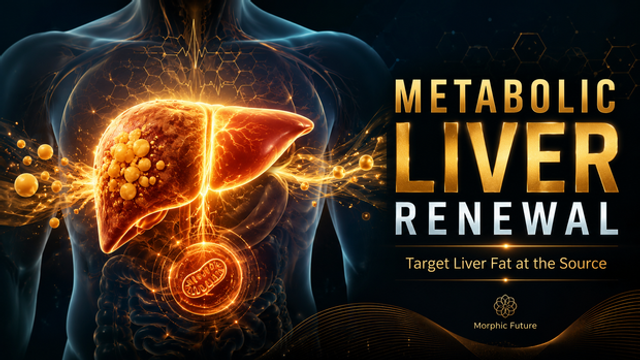
Fatty Liver Recomposition, Insulin Coordination & Hepatic Metabolic Resilience
Purpose
You can lose body fat and still have a liver that stores too much of it.
And you can support liver detoxification without correcting the metabolic conditions that made that fat accumulate in the first place.
Metabolic Liver Renewal is built specifically around that gap.
This premium morphic system works on the mechanisms that determine how the liver receives, creates, stores, mobilizes, burns, transports and clears lipids, while coordinating insulin signaling, mitochondrial energy production, hepatobiliary clearance and the wider liver–muscle–adipose metabolic network.
The objective is not simply to “clean” the liver.
It is to progressively move it away from a fat-storing, metabolically congested state and toward a more flexible, efficient and resilient metabolic environment.
And once that environment improves, the system shifts toward helping it stay that way.
Functional Architecture / Modules
Module 1 — Metabolic Mapping & Adaptive Control
The field begins by identifying the dominant metabolic pressures currently maintaining hepatic fat accumulation.
It evaluates patterns associated with:
Excessive fatty-acid influx
Increased hepatic fat synthesis
Poor fatty-acid oxidation
Triglyceride retention
Insulin resistance
Mitochondrial inefficiency
Metabolic inflammation
Impaired clearance
Rather than applying every mechanism with the same intensity, the system prioritizes the metabolic bottlenecks that matter most.
As conditions change, the field changes its emphasis with them.
Module 2 — Fat Influx & De Novo Lipogenesis Regulation
Liver fat can come from two major directions:
fat arriving at the liver and fat being created inside the liver itself.
This module works on both.
It supports healthier regulation of excessive fatty-acid flow from adipose tissue toward hepatic tissue while reducing unnecessary de novo lipogenesis through metabolic pathways associated with:
SREBP-1c · ChREBP · ACC · fatty-acid synthesis · triglyceride formation
The direction is simple:
less unnecessary fat arriving + less unnecessary fat being created.
Because removing stored fat achieves little if the liver keeps rebuilding it.
Module 3 — AMPK & Insulin Metabolic Reorientation
This module helps move hepatic metabolism away from chronic storage and toward more intelligent fuel use.
AMPK-oriented signaling works alongside improved insulin–liver coordination to support healthier decisions involving:
Glucose utilization
Glycogen storage
Fatty-acid oxidation
Lipid synthesis
Cellular energy demand
The aim is greater metabolic flexibility: the ability to use, store or release fuel according to actual need rather than remaining locked into an excessive storage pattern.
Module 4 — Controlled Hepatic Fat Mobilization
Once excessive incoming pressure and new fat creation are better regulated, the system begins addressing fat already accumulated within hepatic cells.
But there is an important distinction:
mobilizing fat is easy to promise. The real question is what happens to it afterward.
This module therefore coordinates hepatic triglyceride mobilization with the liver’s actual ability to process what is released.
The objective is not aggressive unloading.
It is intelligent metabolic unloading.
Fat is progressively mobilized only within a broader system capable of using, transporting and clearing it.
Module 5 — β-Oxidation, Lipid Export & Hepatobiliary Clearance
This module handles what happens next.
Mobilized fatty acids are directed toward appropriate metabolic destinations through a coordinated combination of:
Mitochondrial β-oxidation
Triglyceride processing
Lipoprotein packaging and export
Hepatic microcirculation
Tissue oxygenation
Bile-flow support
Digestive elimination
Metabolic byproduct clearance
Peripheral fuel utilization
The principle is:
Mobilize → Use → Transport → Clear.
Fat should not simply move from one storage compartment to another.
It should reach an appropriate metabolic destination.
The hepatobiliary layer also supports healthier downstream processing and elimination so metabolic remodeling is accompanied by efficient clearance rather than internal recirculation or stagnation.
Module 6 — Mitochondrial, Redox & Hepatocyte Resilience
Reducing hepatic fat increases the importance of mitochondrial capacity and cellular protection.
This module supports:
Fatty-acid oxidation
Mitochondrial energy production
Cellular ATP efficiency
Glutathione-oriented antioxidant defense
Redox balance
Membrane integrity
Hepatocyte metabolic function
Cellular recovery
The intention is not merely to increase metabolic activity.
It is to make that activity cleaner, more sustainable and better protected.
A supportive hepatoprotective layer helps maintain cellular stability while stored burden is progressively processed and reduced.
Module 7 — Metabolic Inflammation & Fibrotic-Drift Protection
Excessive hepatic lipid accumulation can contribute to an inflammatory environment that further disrupts insulin sensitivity, mitochondrial function and tissue resilience.
This module helps interrupt that cycle.
It supports healthier inflammatory regulation while encouraging balanced extracellular-matrix turnover and protection against progressively maladaptive fibrotic remodeling.
The emphasis is not broad scar removal.
It is preventing metabolic stress from gradually becoming structural deterioration.
Module 8 — Liver–Adipose–Muscle Metabolic Coordination
The liver does not operate alone.
Adipose tissue determines how much fatty acid enters circulation. Skeletal muscle is a major destination for glucose and fatty-acid utilization. Pancreatic signaling influences the metabolic behavior of both.
This module coordinates:
adipose tissue ↔ circulation ↔ liver ↔ skeletal muscle ↔ pancreas
to reduce contradictory metabolic signals and improve whole-system fuel handling.
It supports:
More proportional fatty-acid release from adipose tissue
Reduced lipid overflow toward the liver
Better peripheral use of exported fuel
Greater muscle participation in glucose and fatty-acid utilization
Improved coordination between insulin signaling and substrate availability
The system remains liver-centered, but the metabolic network around the liver is encouraged to support the same direction.
Module 9 — Reaccumulation Resistance, Hepatic Ease & Long-Term Integration
Reducing excessive hepatic fat is not considered the endpoint.
As metabolic conditions improve, the field gradually shifts from active reduction toward preservation.
It reinforces:
Appropriate hepatic fat thresholds
Controlled fatty-acid influx
Reduced unnecessary lipogenesis
Efficient β-oxidation
Healthy triglyceride transport
Metabolic flexibility
Insulin responsiveness
Efficient clearance
Resistance to unnecessary fat redistribution
A subtle additional layer also supports the release of emotional and energetic stagnation associated with chronic hepatic tension, encouraging a calmer internal environment during metabolic renewal.
This is intentionally secondary to the physical metabolic architecture rather than turning the project into an emotional-release field.
The final direction is:
reduce accumulation → process what is released → restore metabolic function → prevent redistribution → resist reaccumulation.
How the System Progresses
Metabolic Liver Renewal follows a deliberate cause-to-effect sequence:
Reduce excessive fatty-acid influx
↓
Reduce unnecessary hepatic fat creation
↓
Improve AMPK and insulin coordination
↓
Mobilize accumulated hepatic triglycerides
↓
Increase mitochondrial fat utilization
↓
Transport and clear what is not immediately oxidized
↓
Support bile flow and downstream elimination
↓
Reduce oxidative and inflammatory interference
↓
Restore metabolically stressed hepatic function
↓
Coordinate liver, adipose tissue, muscle and pancreas
↓
Build resistance against unnecessary reaccumulation
This is what separates the system from a conventional detoxification field or a general fat-loss field.
Benefits
Supports progressive reduction of excessive hepatic fat accumulation
Targets liver-fat metabolism rather than generalized body-fat reduction
Helps reduce excessive fatty-acid overflow toward the liver
Supports healthier de novo lipogenesis regulation
Promotes AMPK-oriented metabolic activity
Improves insulin–liver coordination
Encourages greater metabolic flexibility
Supports controlled mobilization of stored hepatic triglycerides
Strengthens mitochondrial fatty-acid oxidation
Supports healthier triglyceride processing and lipid export
Helps coordinate the metabolic destination of mobilized fat
Supports hepatic microcirculation and tissue oxygenation
Adds hepatobiliary and digestive clearance support
Helps reduce unnecessary lipid redistribution
Reinforces glutathione-oriented antioxidant defenses
Supports metabolically stressed hepatocytes
Promotes healthier inflammatory balance
Helps protect against metabolically driven fibrotic progression
Improves liver–adipose–muscle metabolic coordination
Supports resistance against hepatic fat reaccumulation
Adapts its priorities as metabolic conditions improve
Supports a calmer, less stagnant internal hepatic environment
The Core Difference
Many approaches address one piece of the problem.
Burn more fat.
Improve insulin.
Detox the liver.
Increase metabolism.
But liver-fat accumulation is a chain.
If you mobilize fat without processing it, the problem is incomplete.
If you process stored fat while the liver continues creating too much new fat, the problem returns.
And if the liver improves while the surrounding metabolic network keeps sending it the same signals, the old pattern remains easy to rebuild.
Metabolic Liver Renewal is designed around the whole sequence.
Not simply clearing what is there.
Changing the metabolic conditions that allowed it to remain there.
The goal is not just a cleaner liver.
The goal is a liver progressively less favorable to unnecessary fat accumulation.
1-2 times/day
Disclaimer: This morphic field is intended for personal wellness and energetic support only. It is not a substitute for professional medical advice, diagnosis, or treatment. If you have a medical condition or persistent symptoms, consult a qualified healthcare professional.
Quick-glance key benefits
Hepatic fat recomposition · Reduced lipogenesis · AMPK metabolic shift · Insulin–liver coordination · β-oxidation · Lipid export · Hepatobiliary clearance · Mitochondrial resilience · Glutathione support · Inflammatory regulation · Fibrotic-drift protection · Metabolic network coordination · Reaccumulation resistance




Reviews
There are no reviews yet.