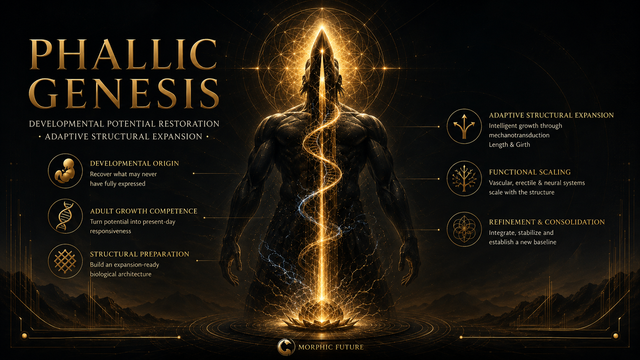
Developmental Potential Restoration · Adaptive Length & Girth Expansion · Structural Male Enhancement
Purpose
PHALLIC GENESIS is a premium morphic system designed around one central objective:
to maximize penile size potential through developmental restoration, localized growth intelligence, regenerative remodeling, adaptive structural expansion, and long-term integration.
Rather than relying primarily on temporary increases in blood volume or indiscriminate hormonal stimulation, the field approaches male enhancement as a coordinated developmental and structural process.
It begins by reconnecting the user’s present biological and energetic blueprint with information associated with optimal prenatal male development and the successive stages of maturation, with the aim of recovering growth potential that may not have been fully expressed.
From there, the system moves beyond developmental restoration by supporting new adult remodeling capacity through localized growth signaling, regenerative processes, extracellular-matrix adaptation, mechanotransduction, cavernous tissue development, vascular scaling, neural integration, and structural maturation.
All prenatal and developmental functions operate exclusively on the present user. The field does not attempt to influence, modify, heal, or work upon either parent.
The central progression is:
Recover unrealized potential → restore growth competence → remodel adult tissue → expand length and girth → scale the supporting systems → consolidate the new architecture.
Adaptive Morphogenic Intelligence
At the center of PHALLIC GENESIS is an adaptive control system coordinating the entire enhancement process.
Instead of maximizing every mechanism simultaneously, it continually evaluates what is most likely limiting further adaptation and adjusts the field accordingly.
It monitors the functional state of:
longitudinal and circumferential capacity;
tunica and extracellular matrix;
cavernous and spongiosal tissue;
smooth-muscle architecture;
vascular and endothelial support;
neural and sensory integration;
androgen and growth-factor responsiveness;
regenerative capacity;
tissue recovery and maturation;
symmetry and proportionality.
Its operating logic follows:
Assess → Prioritize → Prepare → Remodel → Recover → Reassess → Consolidate
The objective is to direct resources toward the current bottleneck rather than applying unnecessary stimulation everywhere at once.
Adaptive Physical Change Acceleration
Integrated into this control architecture is a target-locked physical adaptation accelerator.
Its purpose is not to introduce additional goals, but to increase the responsiveness and speed of the physical changes already selected by PHALLIC GENESIS.
Depending on current needs, it may reinforce:
tissue remodeling;
regenerative response;
mechanotransductive adaptation;
extracellular-matrix reorganization;
vascular development;
neural accommodation;
tissue maturation and consolidation.
The accelerator remains recovery-gated.
If tissue integration, repair, vascular support, or maturation becomes the limiting factor, acceleration automatically shifts toward those processes rather than continuing to intensify expansion.
The principle is:
accelerate only what can be coherently integrated.
Functional Architecture
1. Developmental Potential Restoration
The first stage works with developmental information associated with optimal male genital formation and maturation.
Its purpose is not to literally return the body to prenatal development or puberty.
Instead, it seeks to recover useful developmental patterns, responsiveness, and potentially unrealized structural capacity within the user’s present adult system.
This includes informational support associated with:
optimal prenatal male genital differentiation;
appropriate androgen-responsive developmental programming;
preservation of growth potential during early development;
pre-pubertal developmental readiness;
initiation of male maturation;
peak developmental growth responsiveness;
later-stage maturation and completion of adult male anatomy.
The system therefore considers the complete developmental progression rather than focusing only on adult tissue.
Developmental Interference Correction
A complementary process addresses patterns conceptually associated with incomplete developmental expression, including:
suboptimal developmental signaling;
insufficient receptor responsiveness;
inappropriate hormonal timing;
metabolic stress;
inflammatory burden;
endocrine interference;
other factors that may have limited optimal developmental expression.
The objective is not to rewrite the past itself.
It is to reduce the influence that an imperfect developmental history may still exert upon the present structural blueprint and adaptive capacity.
2. Stage-Optimized Growth & Androgenic Intelligence
Optimal male development depends not simply upon having more hormones, but upon receiving the correct signal, at the correct intensity, in the correct tissue, at the appropriate developmental stage.
This module supports coordinated and predominantly localized activity involving:
androgen-receptor responsiveness;
DHT-related signaling;
appropriate SRD5A2 / 5α-reductase activity;
GH/GHR responsiveness;
IGF-1/IGF1R signaling;
local growth factors;
context-dependent anabolic signaling;
adaptive mTOR-related activity;
receptor density and sensitivity;
appropriate signal timing and duration.
The emphasis is therefore on high-efficiency local responsiveness, rather than excessive systemic hormonal stimulation.
Once developmental potential has been addressed, the same intelligence is redirected toward the adult tissue environment to support new structural adaptation.
3. Adult Growth Competence Expansion
Developmental recovery establishes the foundation, but PHALLIC GENESIS is not intended to stop at the size that might theoretically have developed under more favorable conditions.
The system also seeks to increase the capacity of present adult tissue to respond to controlled remodeling.
This creates two complementary pathways:
Recover potentially unrealized developmental potential.
And then:
develop additional adult adaptive remodeling capacity.
This module bridges developmental restoration with the physical expansion systems that follow.
4. Precision Regenerative Remodeling
Structural expansion requires tissue capable of adapting, repairing, and maturing.
This module supports targeted regenerative and progenitor-cell activity according to actual tissue demand.
Its focus may include:
cavernous smooth muscle;
corpus spongiosum;
vascular endothelium;
connective tissue;
extracellular matrix;
supporting superficial tissue;
repair and remodeling processes.
Rather than attempting indiscriminate proliferation, regenerative activity is coordinated with the structures currently undergoing adaptation.
The principle is:
new tissue should develop only as quickly as it can be vascularized, innervated, organized, and integrated.
5. Tunica & Extracellular Matrix Reengineering
The tunica and surrounding extracellular matrix are treated as active determinants of structural development.
This module supports:
collagen turnover and organization;
collagen/elastin balance;
fibroblast regulation;
proteoglycan and matrix organization;
tissue compliance;
tensile integrity;
longitudinal adaptability;
circumferential adaptability;
connective-tissue remodeling;
anti-fibrotic balance.
The objective is not simply to make the tissue softer or more flexible.
Instead, the field seeks an adaptive balance between:
expandability · elasticity · resilience · structural strength · long-term stability
As dimensions change, the supporting matrix is progressively reorganized so that adaptation can mature into functional structure rather than remain dependent upon temporary stretching.
6. Adaptive Mechanotransduction & Expansion Cycling
This module provides one of the principal structural-remodeling signals of the field.
Rather than reproducing one specific external enlargement technique, PHALLIC GENESIS uses an adaptive internal expansion logic based on progressive mechanical-style signaling and recovery.
Its cycle follows:
Preparation → Expansion Signal → Cellular Adaptation → Matrix Remodeling → Recovery → Consolidation
Longitudinal and circumferential adaptation are calibrated independently.
The system may therefore emphasize different structural vectors depending on what is currently limiting progress.
It also incorporates physiologically inspired cycles of:
expansion → perfusion → relaxation → recovery
to support repeated tissue conditioning, oxygenation, cavernous adaptation, and progressive structural remodeling.
Expansion and recovery remain inseparable:
stimulate → adapt → recover → mature → continue.
7. Dual-Axis Length & Girth Development
Length and girth are treated as related but structurally distinct objectives.
Length Development
Supports coordinated adaptation involving:
longitudinal tunical architecture;
cavernous tissue;
connective support;
vascular pathways;
neural accommodation;
proximal and distal structures.
Girth Development
Supports:
circumferential tunical remodeling;
cavernous volume;
sinusoidal capacity;
smooth-muscle development;
vascular-network expansion;
connective-tissue accommodation.
The adaptive controller continuously balances both dimensions so that growth remains proportionate rather than excessively favoring one axis.
8. Cavernosal, Spongiosal & Glans Architecture
This module coordinates remodeling of the major anatomical structures responsible for size and erectile function:
corpora cavernosa;
corpus spongiosum;
glans;
trabecular smooth muscle;
sinusoidal spaces;
connective support;
urethral-supporting structures.
The glans is developed as part of the overall architecture rather than as an isolated cosmetic target.
Its adaptation is coordinated with shaft dimensions, spongiosal tissue, vascular capacity, sensitivity, and overall proportion.
Supporting Tissue Accommodation
Skin, fascia, superficial connective tissue, urethral structures, and surrounding soft tissues are also supported in adapting progressively to changing dimensions.
The goal is enlargement that remains coherent, proportionate, and anatomically integrated.
9. Demand-Coupled Vascular & Erectile Expansion
A larger structure requires an appropriately scaled vascular system.
Rather than simply increasing blood flow, this module supports vascular adaptation according to structural demand.
It includes support for:
penile and cavernosal arterial function;
microvascular development;
endothelial integrity;
endothelial glycocalyx;
appropriate angiogenic signaling;
vascular maturation;
tissue oxygenation;
NO/eNOS responsiveness;
cavernosal smooth-muscle relaxation;
sinusoidal filling capacity;
healthy intracavernosal pressure;
veno-occlusive support.
A fundamental distinction is maintained:
improved erectile fullness is not automatically interpreted as structural enlargement.
Erectile optimization exists to support and fully utilize the changing anatomy, while structural progress remains dependent upon actual remodeling and maturation.
10. Neural, Sensory & Pelvic Integration
Every structural adaptation should remain neurologically and functionally integrated.
This module supports:
pelvic and autonomic nerve integrity;
adaptive innervation;
healthy sensory signaling;
preservation and refinement of sensitivity;
somatosensory adaptation;
erectile neural coordination;
pelvic-floor integration;
bulbocavernosus function;
ischiocavernosus function;
erection-supporting pressure mechanics.
The nervous system is encouraged to adapt alongside the changing anatomy.
The objective is enhancement without sacrificing sensation, control, comfort, or sexual function.
11. Proportional Morphogenic Refinement
Maximum size alone is not treated as the final objective.
The adaptive system also monitors the quality and proportionality of the resulting architecture.
This includes:
length-to-girth relationship;
shaft uniformity;
glans-to-shaft proportion;
left-right symmetry;
proximal-distal balance;
contour;
structural alignment;
overall aesthetic coherence.
If one area develops more slowly than another, remodeling priority may shift toward restoring balance.
The intended result is:
larger · fuller · proportionate · structurally coherent · functionally integrated.
12. Structural Maturation & New Baseline Formation
Expansion is not considered complete when the first dimensional changes appear.
The final stage progressively shifts emphasis toward tissue maturation and stabilization.
This includes:
extracellular-matrix organization;
collagen/elastin stabilization;
smooth-muscle homeostasis;
vascular maturation;
endothelial stability;
neural integration;
connective-tissue adaptation;
tissue-quality normalization;
anti-fibrotic regulation;
recovery;
structural maintenance.
The aim is to encourage remodeled anatomy to become a new functional structural baseline, rather than remaining dependent primarily upon temporary engorgement, edema, stretching, or continuous high stimulation.
If integration becomes the primary bottleneck, further expansion is automatically deprioritized until the system is ready to continue.
Embedded Male Reproductive Vitality & Renewal
Because PHALLIC GENESIS is designed as a premium system, enhancement is supported by a discreet background layer dedicated to the broader male reproductive environment.
Its purpose is not to transform the field into a general reproductive-health program.
Instead, it helps maintain the systems surrounding the enhancement process.
This may include support for:
testicular vitality;
Leydig and Sertoli cell function;
healthy endogenous androgenic function;
balanced male endocrine signaling;
prostate integrity;
urethral health;
reproductive pathways;
reproductive circulation;
spermatogenic and fertility preservation;
reproductive recovery;
healthy sexual vitality.
These processes remain secondary to the principal structural objective.
Optional Adaptive Functions
PHALLIC GENESIS may also include optional secondary functions for users who want additional emphasis without changing the primary enlargement architecture.
Sexual Vitality
Additional support for healthy libido, sexual drive, stamina, and male sexual vitality.
Fertility & Reproductive Support
Additional emphasis on spermatogenic health, fertility preservation, and reproductive-system integrity.
Pelvic Performance
Greater emphasis on pelvic-floor coordination, erection-supporting pressure mechanics, and neuromuscular control.
Sensory Optimization
Additional support for sensitivity, neural adaptation, and balanced sexual sensation.
Reproductive Renewal
Additional restorative emphasis for the testes, prostate, urethra, and surrounding reproductive structures.
Deep Developmental Pattern Clearing
An optional clearing mechanism designed to address deeper patterns only when they are genuinely relevant to the developmental and structural objective of the field.
The system does not assume that ancestral trauma, past-life experiences, karmic influences, emotional history, or other subtle factors necessarily determine physical anatomy.
Instead, it operates conditionally.
If an inherited, transgenerational, emotional, energetic, karmic, or deeper developmental pattern is identified as an unnecessary limitation upon developmental expression or physical adaptation, this layer may support its release or neutralization.
The purpose is simply to ensure that no relevant deeper pattern unnecessarily interferes with the expression of developmental potential or the structural remodeling process.
It remains fully subordinate to PHALLIC GENESIS and does not redirect the field toward general ancestral, trauma, karmic, or past-life work.
Integrated Safeguard Intelligence
Throughout the entire process, the adaptive controller prioritizes coherent development over indiscriminate stimulation.
It is designed to discourage patterns associated with:
excessive fibrosis;
poorly organized collagen;
disproportionate expansion;
unnecessary inflammatory stress;
excessive edema;
vascular-to-tissue mismatch;
sensory deterioration;
insufficient recovery;
structural instability;
unnecessary systemic hormonal effects.
Its hierarchy is:
Integrity → Adaptive Capacity → Structural Expansion → Functional Integration → Proportional Refinement → Consolidation
The objective is therefore not simply maximum stimulation.
It is:
maximum coherent structural development.
Benefits
Supports recovery of potentially unrealized developmental growth potential.
Works with information associated with optimal prenatal male genital development while acting exclusively on the present user.
Supports the successive maturation stages relevant to male genital development.
Addresses developmental patterns that may have limited optimal structural expression.
Supports stage-optimized androgenic and growth-factor signaling.
Supports localized AR and DHT-related responsiveness.
Supports GH/GHR and IGF-1/IGF1R responsiveness.
Includes adaptive, context-dependent growth signaling.
Supports acquisition of additional adult remodeling capacity.
Includes target-locked physical adaptation acceleration.
Accelerates only those processes already selected by the core system.
Automatically shifts acceleration toward recovery when integration becomes limiting.
Supports targeted regenerative and progenitor-cell activity.
Supports tunica and extracellular-matrix remodeling.
Encourages collagen/elastin organization and adaptive tissue compliance.
Includes anti-fibrotic structural support.
Uses adaptive mechanotransductive remodeling.
Incorporates expansion–perfusion–recovery conditioning cycles.
Supports progressive length development.
Supports progressive girth development.
Coordinates length and girth independently for improved proportionality.
Supports corpora cavernosa remodeling.
Supports corpus spongiosum development.
Supports proportional glans enhancement.
Supports smooth-muscle and sinusoidal architecture.
Supports skin, fascia, connective tissue, and urethral accommodation.
Scales vascular capacity alongside structural development.
Supports microvascular and endothelial adaptation.
Supports NO/eNOS responsiveness and stronger erectile capacity.
Distinguishes genuine structural progress from temporary erectile fullness.
Supports neural adaptation and preservation of sensitivity.
Supports pelvic-floor integration and erection-supporting mechanics.
Encourages symmetry, contour, proportionality, and aesthetic coherence.
Supports reproductive-system integrity throughout the enhancement process.
Supports testicular, prostate, urethral, and reproductive-pathway health.
Supports healthy fertility and sexual function.
Offers optional sexual vitality, fertility, pelvic, sensory, and reproductive support.
Optionally addresses deeper developmental patterns when genuinely relevant.
Prioritizes repair and maturation whenever structural integration requires it.
Supports progressive stabilization of remodeled anatomy into a more mature functional baseline.
Core Design Philosophy
PHALLIC GENESIS follows a coordinated cause-to-effect progression:
Developmental Potential
→ Growth Competence
→ Adult Adaptive Capacity
→ Regenerative Preparation
→ Matrix Adaptation
→ Mechanotransductive Expansion
→ Length & Girth Development
→ Vascular & Neural Scaling
→ Functional Integration
→ Structural Consolidation
Its integrated acceleration system reinforces adaptation only when the relevant structures are ready to support it.
The field therefore does not simply issue a generalized instruction to become larger.
It attempts to determine:
what is limiting further development → what must adapt next → what support that adaptation requires → when growth should continue → when recovery should take priority.
The intended result is a progressively remodeled male architecture built around:
greater length · greater girth · fuller structural development · proportional glans enhancement · stronger erectile capacity · preserved sensitivity · reproductive integrity · aesthetic proportionality · deeper structural stabilization.
Quick-Glance Key Benefits
Prenatal Developmental Blueprint · Unrealized Potential Recovery · Complete Maturation Support · Localized AR/DHT/GH–IGF Intelligence · Adult Growth Competence · Adaptive Physical Change Acceleration · Precision Regenerative Remodeling · Tunica & ECM Reengineering · Adaptive Mechanotransduction · Length + Girth Expansion · Cavernosal Development · Glans Enhancement · Vascular Scaling · Erectile Capacity · Neural & Sensory Integration · Pelvic Support · Reproductive Renewal · Optional Deep Developmental Pattern Clearing · Anti-Fibrotic Protection · Proportional Morphogenesis · Structural Consolidation
Important Note
PHALLIC GENESIS is conceived as an energetic/morphic enhancement system. Biological terminology describes the intended informational architecture of the field and should not be interpreted as a clinically established method of anatomical enlargement or as a substitute for medical care.




Reviews
There are no reviews yet.